

Converting different types of inspection material into structured reporting outputs
Company
Lotus Demolition Oy
Industry
- Construction
- Real Estate & Property Management
Problem
Lotus Demolition Oy provides demolition services as well as building inspections and surveys. Its work includes renovation, building, property and industrial demolition, asbestos and hazardous-material removal, and inspection services such as condition surveys, indoor-air-quality surveys and pre-demolition audits. Building condition assessments support decisions before maintenance, renovation, or demolition by evaluating a property’s physical state, safety, and functionality; identifying deficiencies; checking relevant requirements; and informing future maintenance and investment planning.
A building condition report brings together findings from document review and a systematic walk-through survey. It records the condition of building structures and technical systems, identifies deficiencies, assigns condition ratings, recommends further investigations or corrective actions, and may include estimated repair costs and a long-term maintenance proposal. In this use case, the required report follows Finnish national guidelines for the condition assessment of commercial and other non-residential properties. It is an extensive nine-part document covering the introduction, general property information, site and building structures, HVAC systems, electrical systems, information technology systems, and an assessment of development needs, long-term maintenance proposal, and conclusions.
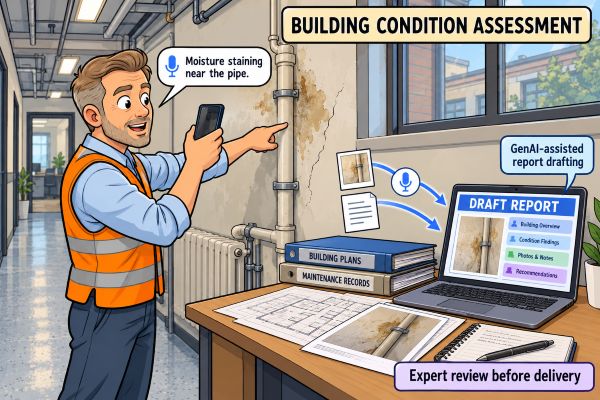
Preparing the report requires surveyors to combine site observations with extensive background material, including previous reports, maintenance records, plans, photographs, written notes and voice recordings. Organising this information into a consistent technical report is a time-consuming and labour-intensive knowledge synthesis process. Lotus Demolition Oy needs a more efficient way to prepare a report draft while keeping technical experts responsible for checking and completing the content. The business goal is to reduce report-preparation time and cost and, if the approach proves reliable, support more competitively priced inspection and survey services.
Solution
The solution supports knowledge synthesis by converting different types of inspection material into structured reporting outputs. Users can choose between a full Report Writer for extensive building condition reports and two smaller, more generic tools that automate selected reporting tasks. This provides different ways to use AI depending on the type and scope of the inspection assignment.
The full Report Writer processes building documents and field material, such as photographs, voice recordings and notes, and generates a structured draft building condition assessment report in Finnish. Its workflow includes processing and selecting source material, refining the selected information, and generating all or selected sections of a nine-part report. Users can review intermediate results, adjust the selected sources and regenerate individual report sections. Every generated report must be checked and completed by a qualified expert before delivery.
Based on the company’s practical needs, the pilot also includes a small Report Writer tool with two focused functions. The Inspection Data Processor analyses photographs and related audio recordings and produces a report in which each photograph is accompanied by the corresponding description provided by the inspector. The Historical Documentation Analyzer reviews earlier property documentation and produces a summary and recommendations concerning the most relevant documents for the assignment. Both the full and small versions are currently being tested. Additional flexibility for templates and prompts, including a prompt library, is planned.
The tools were co-developed with Haaga-Helia University of Applied Sciences in the GAIK project. Reusable GAIK GenAI Toolkit capabilities were configured and combined for processing source material, refining information and generating reports. The company contributed practical requirements, report structures, test material and feedback that guided the development of both the full and Lite versions.
Outcome
We consider the pilot successful as a proof of concept. The tools can perform the required reporting tasks, and company feedback indicated that they work well, especially for the department responsible for this use case. The pilot has given us a clearer understanding of the capabilities of generative AI and what would be required to develop a production system.
Testing Report Writer tools has demonstrated the value of providing different levels of AI support. The small tools offer a practical way for users to become familiar with AI capabilities through focused reporting tasks and generic reports, while the full Report Writer supports more extensive report preparation for a specific report type. Additional testing with varied source material and different assignments is required to evaluate how consistently the tools perform.
ROI
Quantitative ROI has not yet been measured. The expected value would come from reducing manual document review and report-writing effort, shortening report preparation time and lowering delivery costs. Possible future indicators include expert hours per report, report turnaround time and cost per completed inspection report.
Technologies
- AI: Natural Language Processing (NLP), Speech Processing, Computer Vision
- Azure Cloud; GAIK GenAI Toolkit; OpenShift Kubernetes (CSC Rahti)
Partners
Haaga-Helia University of Applied Sciences: primary development partner; co-developed the pilot with Lotus Demolition Oy as part of the GAIK project.
Process Impact
- Facilities & Asset Management
Languages
- Finnish