
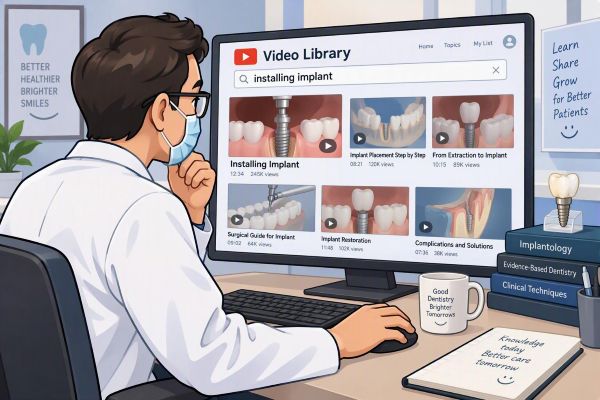
Search the content of videos using ordinary questions or phrases and go directly to the relevant section of a video
Company
QAdental (Suomen Kotilääkäripalvelu Oy)
Industry
- Healthcare & Life Sciences
- Education & E-learning
Problem
QAdental provides continuing education content for oral healthcare professionals through a growing library of webinars, lectures, vodcasts, procedure videos, and case discussions. Valuable knowledge is embedded inside long recordings, but the library’s existing search functions make it difficult for users to locate a specific topic, explanation, or moment without knowing which video contains it and browsing the recording manually.
The challenge is not only finding the right video. A user may need a quick answer to a focused professional question or direct access to the exact section where a concept is discussed. This creates an opportunity to move from course-centred access toward knowledge-centred access: instead of requiring a professional to know which lecture to watch, relevant expert knowledge can be discovered across the entire content library based on the user’s actual information need. Conventional title- and keyword-based browsing cannot reliably support this, especially when relevant concepts are expressed using different terms or synonyms.
From a knowledge-access perspective, QAdental therefore needed a practical solution that would allow users to search the content of its videos using ordinary questions or phrases and go directly to the relevant section of a video. The search also needs to fit QAdental’s own hosted video library and future content-management workflow. Because the source material concerns oral healthcare, the solution must avoid presenting automatically generated responses as medical advice and should direct users back to the underlying educational material and its context.
Solution
The AI-assisted knowledge-access solution indexes QAdental’s educational videos and subtitle tracks so that users can search the library using natural-language queries. Search results point users to the relevant video and timestamp, enabling direct access to the section where a topic is discussed instead of requiring users to browse an entire recording manually.
The pilot combines semantic search, keyword search, and subtitle-cue matching operating on the tool’s knowledge base. It also includes an “Ask the videos” function that generates answers from the indexed content using an AI agent. The hybrid search ensures high-quality retrieval by combining domain-specific terminology through keyword search and semantic search from the vector store.
QAdental’s feedback showed that this function needs clear framing and a disclaimer so that answers are not interpreted as clinical guidance. An important design principle is traceability: AI-generated answers should remain connected to the underlying expert content, allowing the user to inspect the original video segment and its wider educational context. Cross-language search, broader multilingual support, API-based import, and integration with QAdental’s own video library remain future development steps.
The solution was co-developed in the GAIK project, which addresses knowledge capture, knowledge access, and knowledge synthesis. The tool uses GAIK project’s specialized transcriber that uses Finnish finetuned transcription models and transcription enhancement methods to generate accurate transcripts from audios/videos. The transcripts of audios/videos with the generated metadata (e.g., timestamps, thumbnails, sub-titles, video description, etc.) are indexed in a vector store that serves as the tool’s knowledge base. QAdental provided the video-library context, requirements, test material, and feedback, while reusable knowledge-access components from the GAIK GenAI Toolkit were configured for the company-specific pilot. Haaga-Helia University of Applied Sciences was the primary development partner, the University of Helsinki supported testing and evaluation, and Tampere University conducted an AI adoption readiness assessment.
Outcome
We found the semantic video search to be highly promising and were impressed by how well the pilot worked. Compared with the rudimentary search in our current library, it provides a much more practical way to find relevant content and go directly to specific moments in videos. During the feedback meeting, the pilot contained more than 55 videos.
Once we understood the available search modes, the solution was straightforward to use, and the search generally worked well. The pilot demonstrated the practical potential of semantic search to improve access to the knowledge contained in our educational video library.
Based on the pilot, we consider integration into our future service very feasible and support proceeding toward a production system.
ROI
Quantitative ROI has not been measured at the pilot stage.
The expected sources of value are faster access to relevant knowledge inside long videos, less time spent browsing recordings manually, improved discoverability and reuse of QAdental’s existing educational content, and a better user experience in the video library. The feature may also strengthen the value of QAdental’s educational service by allowing users to obtain focused access to content that is currently difficult to find.
These benefits remain expected rather than measured. ROI can be evaluated after broader user testing and workflow integration by comparing search success, time needed to locate relevant content, feature usage, user satisfaction, and engagement with indexed videos against the current library experience.
Technologies
- AI: Natural Language Processing (NLP), Agentic AI, keyword search, semantic search, retrieval augment generation
- Closed selection: Azure
- Free-text field: GAIK GenAI Toolkit; Azure OpenAI embedding models; PostgreSQL with pgvector; hybrid semantic and keyword search; CSC Rahti and Allas.
Partners
Haaga-Helia University of Applied Sciences: primary development partner; co-developed the company-specific pilot and reusable GAIK GenAI Toolkit components. University of Helsinki: supported testing and evaluation. Tampere University: conducted an AI adoption readiness assessment.
Process Impact
- Product Development & Innovation
Languages
- Finnish
- English