
GenAI Toolkit for Smarter Knowledge Work
The GenAI toolkit will provide several smart services both for internal business processes and for enhancement of customer experience. It will enable companies and technology providers to develop easy-to-deploy knowledge management solutions using business data with user-friendly software components (modules & code libraries), guidelines, process models, templates, and reusable knowledge models.
GAIK Toolkit Launch - Feb 4, 2026!
First public version of the GenAI toolkit will be launched, check more details from the event page!
Toolkit Vision
The GAIK toolkit development is grounded in practical experience gained through our involvement in the Finnish AI Region (FAIR) project, where we provide AI consultancy services to companies while systematically observing their adoption challenges and requirements. This experience revealed that knowledge management manifests differently across organizations but follows recognizable patterns that create recurring implementation barriers. These observations directly inform our toolkit design, ensuring that research contributions address real-world business needs while advancing theoretical understanding of AI applications in knowledge work environments.
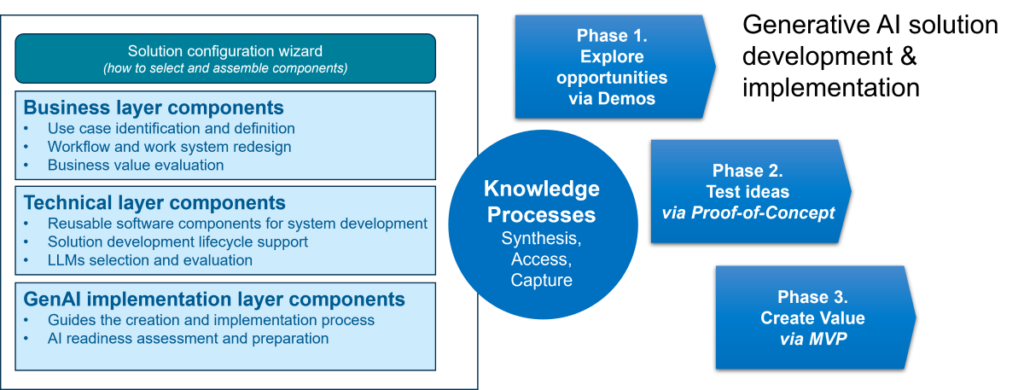
Our previous analysis shows that knowledge management challenges can be systematically categorized into three fundamental processes: knowledge access, knowledge extraction, and knowledge generation. These processes manifest across diverse business environments and represent the core bottlenecks that organizations face when attempting to leverage their information assets effectively.
To address these three dimensions of knowledge management, we are developing a GenAI toolkit that enables businesses to create their own use cases spanning one or more knowledge management processes through an intuitive and interactive approach. The toolkit comprises reusable, shareable, and modifiable modular components that function as building blocks for developing GenAI-powered knowledge management solutions and automating knowledge workflows.
The GAIK toolkit distinguishes itself from existing frameworks through several key innovations. It applies a coherent and focused approach specifically designed to address knowledge management challenges in business contexts rather than providing generic AI solutions. The toolkit accommodates users on a larger scale across the technical expertise spectrum, enabling company executives and managers to create use cases while providing customization and improvement capabilities for AI developers and technical specialists.
Modular Component Architecture
Our approach emphasizes the creation of reusable templates for knowledge management processes that maintain compatibility across different platforms and frameworks. The toolkit provides intuitive guidance throughout the use-case creation process, making GenAI capabilities accessible without requiring deep technical knowledge. Additionally, the modules within the toolkit are designed as independently deployable components that can function as services, endpoints, or Model Context Protocols (MCPs).
Continuous Support via Community Building
As an open-source framework, the toolkit supports continuous evolution through community contribution and AI democratization, inviting researchers, developers, and practitioners to participate in enhancement and extension activities. This approach builds a collaborative ecosystem where solution users and AI developers engage in the toolkit’s continuous improvement while contributing to the broader knowledge management research community.
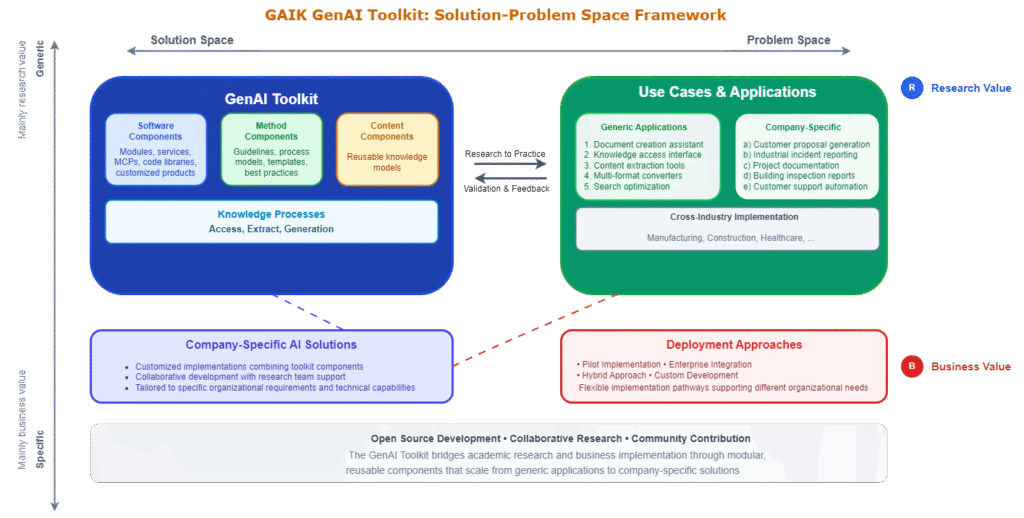
Solution-Problem Space Framework
The GenAI Toolkit is designed around a bridge between solution space and problem space, connecting research-driven components with real-world business challenges. This architecture ensures that academic research translates directly into practical value while maintaining the flexibility to address diverse organizational needs.
The toolkit operates along a strategic continuum from generic research value to specific business value, allowing users to engage at their appropriate level of technical complexity while providing pathways for growth and customization. This design philosophy reflects our core research finding that successful AI adoption requires scalable complexity that adapts to user capabilities rather than imposing uniform technical requirements.